Evolvulus alsinoides | Vishnukranthi
Gallery
Evolvulus alsinoides
 Flower
Leaf
Fruit
Stem
Root
Flower
Leaf
Fruit
Stem
Root
Description
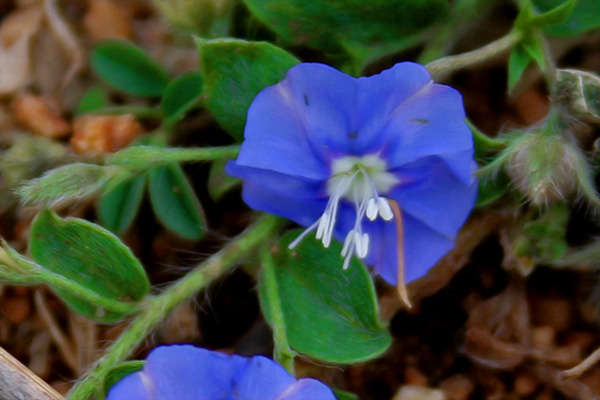
It is a herbaceous plant, annual or perennial, with more or less numerous, prostrate or ascending stems, slender, with appressed and spreading hairs. The leaves, petiolate or subsessile, are 0.7 to 2.5 cm long and 5 to 10 mm long. The flowers are isolated or grouped in pauciflorous cymes, borne by filiform peduncles, 2.5 to 3.5 cm long. The calyx is formed by villous, lanceolate sepals 3 to 4 mm long. The rounded corolla, with pentameric symmetry, blue in color, rarely white, is 7 to 10 mm in diameter. The stamens, with filiform filaments, are united at the base of the corolla tube. The ovary, glabrous, is surmounted by two free styles. The fruit is a globular capsule, with four valves, generally containing four seeds that are black and smooth.
Ecology
The species inhabits a wide range of habitats, from marshland and wet forests to deserts. A number of varieties and subspecies are recognised. It may become a weed in some situations. It is one of the plants included in Dasapushpam, the ten sacred flowers of Kerala.
Read More >Importance
This herb used in traditional medicine of East Asia for its purported psychotropic and nootropic properties. Although such claims are not medically verified. Chemical compounds isolated from E. alsinoides include scopoletin, umbelliferone, scopolin and 2-methyl-1,2,3,4-butanetetrol.
Read More >
Evolvulus alsinoides
Flower
Leaf
Fruit
Stem
Root